Evolutionary Ecology
While in evolutionary studies we mainly focus on how populations or individuals evolve, in ecological ones the interactions between individuals and between individuals and the their environmental is the central focus. In the real world this distinction does not exist, with evolutionary an ecological processes that intertwin and produce the amazing diversity of life that we can observe. Being by definition at the interface between evolution and ecology, evolutionary ecology studies the evolution of organisms and how it is influenced by the interaction with the environment and with other species. This exciting field is multi-disciplinary as a necessity, and includes, for example, the study of coevolution, behaviour, mimicry and anti-predator strategies.
Colour evolution
During my PhD I studied the evolution of colour polymorphism in an invasive moth, Cydalima perspectalis.
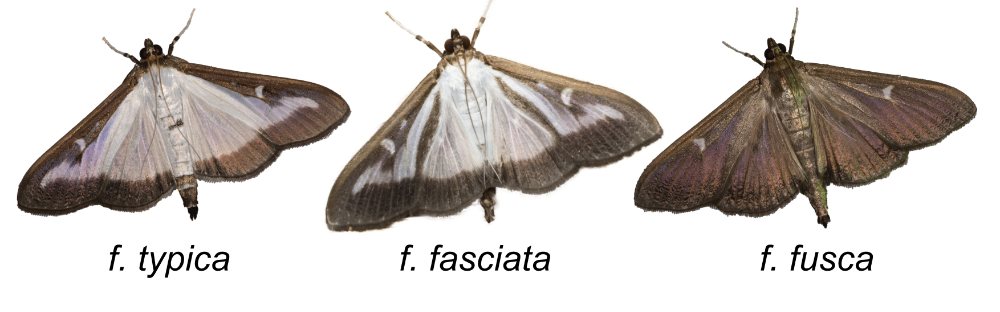
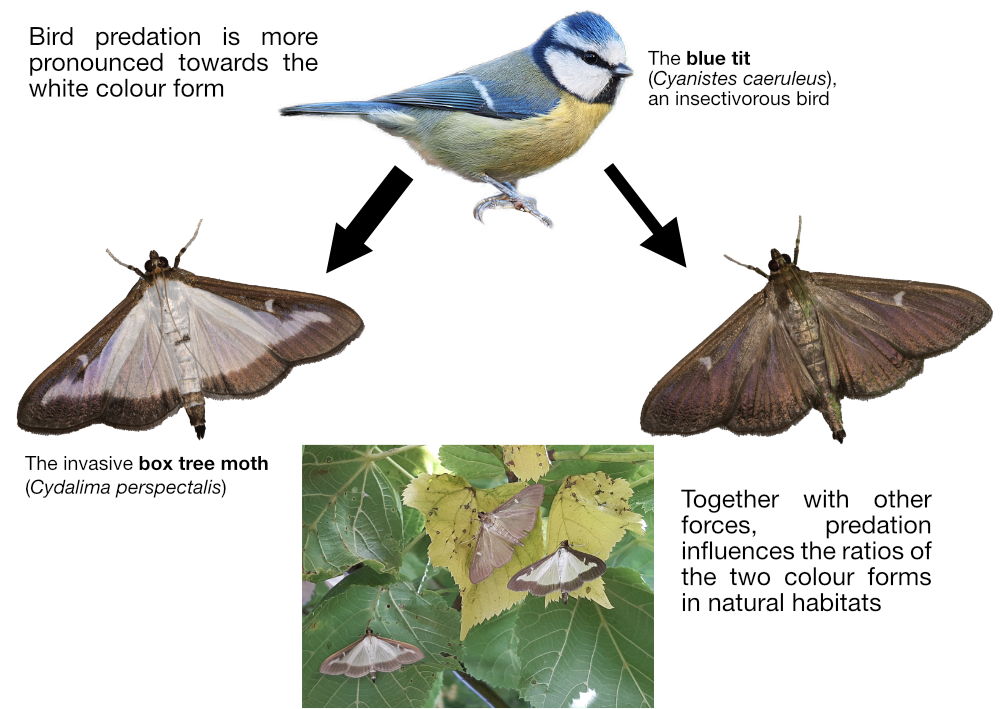
In our 2023 paper, we explore how the polymorphism of the box tree moth influences the predation levels using predation experiments with blue tits. Bird predation often influences colour evolution in butterflies, which are actively hunted by birds. In this paper, we showed how birds can actively prey on the invasive box tree moth, with the white colour form being the most hunted, with a positively frequency-dependent trend (the white moths are less hunted if they are abundant in the population), which is not expected for palatable prey like the box tree moth. Together with other forces, predation can influence the ratios of colour forms observed in natural habitats
 Riccardo Poloni | insect evolution and ecology